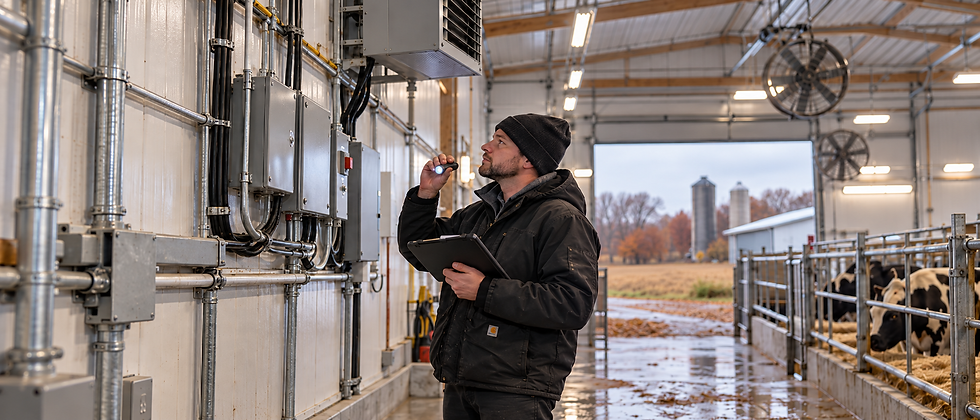
Stray Voltage and Livestock: What a London Dairy Case Study Reveals

| The stressor most producers never check

Genetics, nutrition, ventilation, water quality. Every livestock producer knows the factors that drive performance. Electricity rarely makes the list.
Yet in modern dairy, swine, and poultry barns, where animals are in constant contact with metal, water, and concrete, electrical conditions can quietly shape comfort, behavior, and performance, without ever showing up as an obvious problem.
A recent case study at London Dairy in Southwestern Ontario shows what happens when you finally make the invisible visible.
| What stray current is, and why animals feel it
Every electrical system is bonded to ground by code. As a result, small amounts of current naturally circulate through grounding systems, in homes, businesses, and farms alike. That's normal.
Barns are different. Livestock contact multiple conductive surfaces at once: water lines, metal rails, wet floors. Under the right conditions, circulating current can create small voltages between those surfaces, too subtle for people to feel, but not for animals.
The result is rarely dramatic. It looks like reluctance to drink, hesitation at the stall, inconsistent intake, or agitation during handling. Easy to blame on something else.
| Making the invisible measurable
PrevTech installed Electrical Network Monitoring across London Dairy, with a sensor on every breaker panel feeding a central controller. On-farm faults could now be caught and corrected as they appeared. No guessing. Decisions on data.
A specialized sensor was also placed on the main bonding jumper, where current returns through the grounding path. Once on-farm issues were resolved, any remaining current could be traced to off-farm sources.
The data was clear.
3–4 A continuous current through grounding ·
2 electrical services monitored
Currents like this are not abnormal. But for the first time, the farm could actually see them.
| From detection to control
After several months of monitoring, London Dairy installed a PrevTech Stray Voltage Blocker on both main services, reducing current through livestock contact areas while maintaining proper electrical safety paths.
Herd turnover made a clean before-and-after milk comparison impossible. But two operational indicators stood out: increased water consumption and improved feed intake ratios, both closely tied to herd comfort and metabolic performance.
Not a controlled study. But practical confirmation that electrical conditions can influence animal behavior in subtle, meaningful ways.
| The fire risk most producers underestimate
Herd comfort is only half the story. More than 50% of farm fires are caused by electrical faults and anomalies (Ontario Fire Marshal). Continuous monitoring catches the deteriorating wiring, leakage currents, and faulty connections behind those numbers, often long before they become a loss.
| Why expertise beats an alarm

The London Dairy results didn't come from a box on the wall. They came from a method: stabilize the on-farm system first, confirm a single proper neutral-to-ground bond, then isolate and control off-farm current. And from an expert team interpreting the data and acting on it.
That's the difference. PrevTech doesn't just detect, it controls. And every client works with a team of electrical safety experts, not just a sensor.
"Electrical conditions in a dairy barn are easy to overlook because they're invisible."
-Tommy Faulkner, London Dairy
| The takeaway for every livestock producer
Whether you run dairy, swine, or poultry, the lesson is the same: electrical conditions can be measured, monitored, and managed. Proactive collaboration beats reactive repair every time.
Want to know what's circulating through your barn?
Read the full London Dairy case study below, or contact the PrevTech team to assess your facility.